



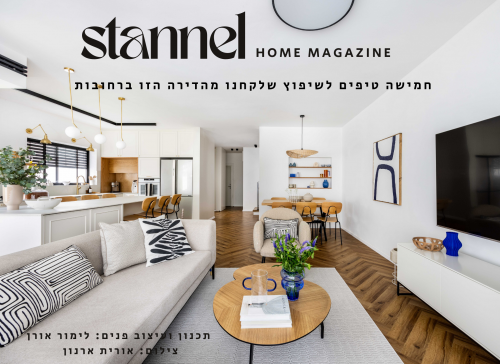
Renovating a home is a complex process, and believe us, we are well aware of the hesitations, pressures, and emotions that arise during the various stages of renovation.
This house in Rehovot, a private house about 14 years old and spanning three floors, was purchased by a family of five.
Ofri Paz | Stanley Home
They faced an extensive three-month renovation, which included significant structural changes, as well as the planning and construction of a dream unit for their eldest daughter and the addition of a new bathroom in the basement. If you too are about to renovate an existing property, here are some things you can learn from the process this family went through together with interior designer and home decorator Limor Oren.
1. Sometimes you have to give up something to gain something else.
Compromises are an integral part of the process of building and renovating. But the story of this house highlights that sometimes compromises and constraints can lead to creative solutions that ultimately serve the people who live in the house better. In the kitchen, for example, the family gave up the utility room in favor of a more spacious and open space, as well as one window, which was replaced by tall kitchen units. In its place, another window was expanded, flooding the kitchen with natural light and bringing all the bounty of the garden inside.

Need another example? Look at the guest bathroom, where it was decided to forgo a shower stall in favor of a long wooden counter, above which is a sink and below it is a wooden ladder for placing toilet paper. The result is functional, bright, and more spacious.

2. When placing furniture, you sometimes have to think in reverse.
“The clients requested a large kitchen with a wide island in the center, allowing for sitting in front of the central space and watching television from the kitchen,” says designer Limor Oren. “The entire seating arrangement in the living room was rotated toward the wall where the sofa previously stood,” she adds. In fact, she rotated the arrangement of the furniture in the living room and placed the sofa in the center of the space in order to meet the family’s request.

3. It’s worth investing in custom carpentry
“Storage space is the central request in almost every project,” the designer emphasizes. To make the most of the existing space, she designed custom-made joinery with in-depth thought about every detail. In the entrance, for example, a storage unit was designed that connects to the kitchen joinery via wall paneling, and includes a coat and shoe cabinet, an electrical cabinet, and a utility cabinet for the vacuum cleaner and cleaning supplies. Don’t miss the bathroom she designed for the two young boys on the top floor, where she placed the walk-in washing machine and dryer in the cabinet, which also contains storage for towels and cleaning supplies. Between the machine and the dryer, she designed a pull-out shelf on a rail for maximum convenience when emptying the dryer.

4Small touches of color can make a big impact.
The house is dominated by a quiet color scheme centered on light brown tones, wood, and touches of black and white. Small touches of blue make the space pop and add lightness and a youthful look. The blue light fixture placed next to the television and coordinated with the decorative pillows and complementary accessories is particularly striking. Limor emphasizes – “I am always in favor of choosing furniture in a neutral shade, on which the space can be dressed up and changed using different colors of the decorative details and textiles in each period. In this way, the house actually stretches its face and changes its atmosphere every time.”

5. The openings in the house are not obvious, treat them creatively
The essence of the openings is to create a transition between rooms and between the interior and the exterior and to transmit light and air. But the truth is that we were surprised by how much creativity and thought was devoted to the openings in this project. Each opening was treated in a way that suits it. Among the windows, some were closed, some were expanded, some were newly created, and some were given new black aluminum profiles. A railing on the upper floor became a partition of wooden bars and above it a ceiling window opened that floods the entrance to the rooms with natural light. In the parents’ unit, the bathroom was expanded at the expense of the closet room and instead of closing the unnecessary door as a wall, it was decided to design a floor-to-ceiling glass wall in it, which creates symmetry with the door on the right, which was expanded and also made of corrugated glass.

Planning and Design: Limor Oren Interior Design and Home Furnishing
Photo: Orit Arnon

Subscribe to our lifestyle channel newsletter
Error: Contact form not found.
Subscribe to our lifestyle channel newsletter
Subscribe to our lifestyle channel newsletter